How to Launch a Multi-Vendor E-Commerce Platform & Storefront SaaS in 2026: The Complete PHP & MySQL Blueprint
A comprehensive architectural guide to building, hosting, and monetizing a self-hosted multi-seller digital marketplace with custom domains, physical/digital inventory, instant UPI checkout, and SaaS subscription tiers.
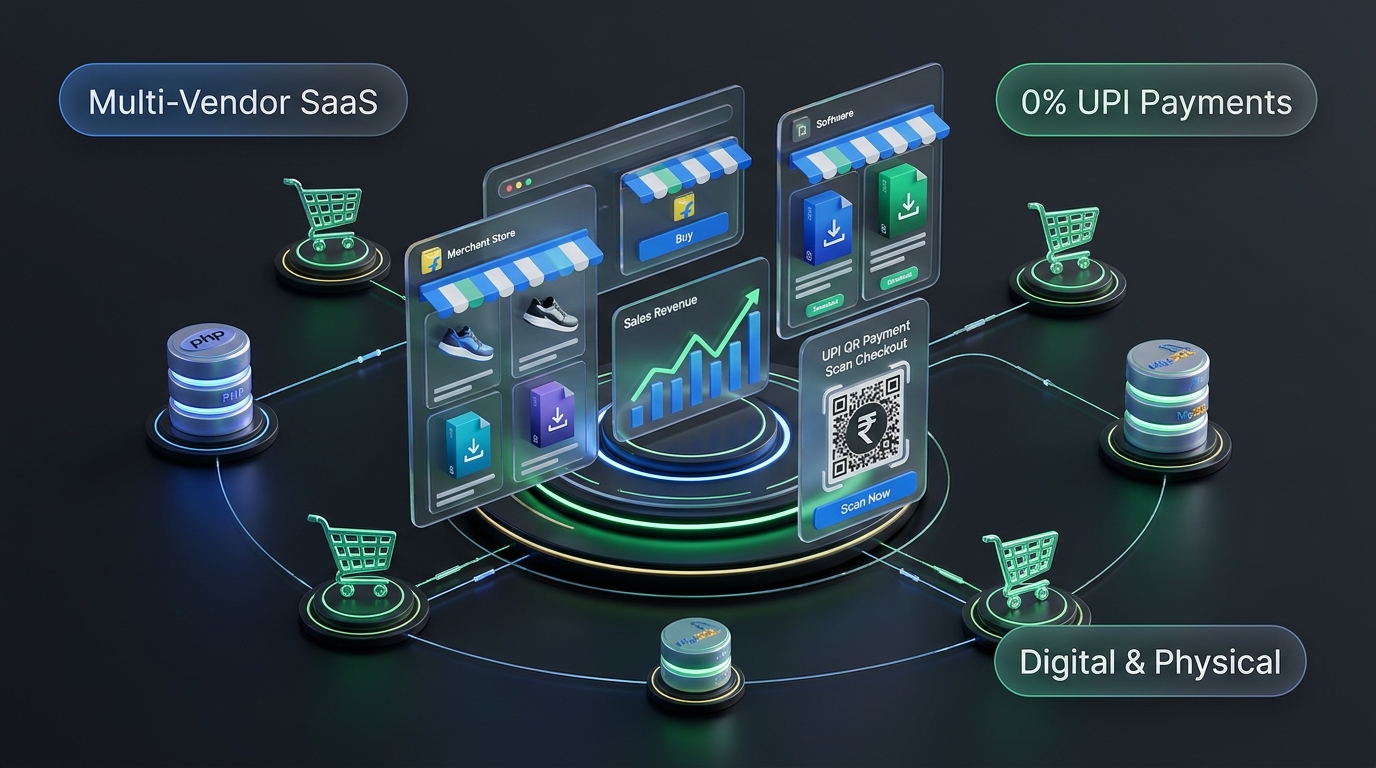
The Great E-Commerce Decentralization: Moving Beyond Shopify in 2026
The global e-commerce software market is undergoing a massive structural transformation. For the past decade, platforms like Shopify, BigCommerce, and WooCommerce dominated online retail. However, for indie entrepreneurs, digital creators, local business networks, and software founders operating in India and emerging markets, traditional proprietary e-commerce platforms have created substantial economic friction:
- The Compounding SaaS Tax: A standard Shopify storefront begins at $39/month (approx. ₹3,300/month), rapidly escalating to $105/month and $399/month for advanced reporting and additional staff seats. When adding essential third-party apps for reviews, upsells, discount tiers, and WhatsApp alerts, merchants routinely pay over ₹10,000 to ₹25,000 every single month in fixed software overhead.
- Aggregator Gateway Fees: Aggregators deduct an additional 2.0% to 3.0% transaction fee on every order, cutting heavily into gross merchant margins.
- The Multi-Vendor Barrier: Launching a multi-seller marketplace (where hundreds of independent vendors manage their own storefronts under one umbrella) on Shopify requires enterprise plans or expensive third-party plugins that cost thousands of dollars annually.
This has created an explosive software opportunity: Self-Hosted Multi-Vendor E-Commerce & Storefront SaaS Platforms.
By operating your own multi-seller marketplace built with pure PHP 8+ and MySQL, you maintain 100% ownership of your customer database, charge vendors recurring SaaS subscription fees or transaction commissions, provide instant 0% fee UPI QR checkout, and run on affordable ₹150/month shared or cloud hosting without external software tolls.
In this technical blueprint, we explore how to build and operate a high-converting multi-vendor marketplace platform and examine how the [Multi-Vendor E-Commerce Platform & Storefront Script (MKart Pro)](/product/multivendor-ecommerce-platform-and-digital-st-mvbbqk1c-i3hm) provides a turnkey, production-ready foundation.
4 Core Architectural Subsystems of a Production Marketplace
A commercial multi-vendor platform combines four deeply integrated architectural layers:
1. Centralized Executive Super Admin Panel
The platform owner commands complete visibility and control over all platform commerce:
- Real-Time Financial Telemetry: Live overview of total Gross Merchandise Value (GMV), daily order volumes, active merchant storefronts, paid subscription plans, and new merchant registrations.
- SaaS Subscription Tier Manager: Build custom Free, Pro, and Enterprise tiers. Set granular limits on product listings, categories, custom domain permissions, coupon codes, and platform branding watermark removal.
- Multi-Gateway Configuration: Toggle and manage native Indian UPI QR, PhonePe, Paytm, BharatPe, and manual bank transfer settlement routes.
- Global Broadcasts & Announcements: Broadcast promotional announcements, flash sale alerts, and system notifications across all merchant storefronts with a single click.
- Automated WhatsApp (via [WAPI](https://wapi.lushai.dev)) & SMTP Integration: Connect WhatsApp webhook engines to dispatch automated real-time order alerts and digital download receipts to buyers.
2. Independent Merchant / Store Owner Cockpit
Every registered vendor receives an isolated, distraction-free administrative dashboard:
- Custom Storefront URL & Custom Domains: Launch an instant branded store at
/store/brand-nameor map an apex custom domain (store.brand.com) on Pro tiers. - Physical & Digital Inventory Management:
- Physical products with low-stock threshold alerts, weight calculation, SKU management, and multi-variant matrices (Size, Color, Edition).
- Digital software and downloadable assets protected by encrypted tokenized attachments and automated expiring download links.
- Bulk CSV product import and export tools for rapid inventory migration.
- Order Fulfillment Pipeline: Track orders through real-time states (Pending, Processing, Completed, Cancelled).
- Discount Coupons Engine: Create custom promo codes with percentage or flat amount discounts, minimum cart spend limits, usage quotas, and expiration dates.
- Store Customizer & Themes: Switch seamlessly between Modern Minimalist and Neo-Brutalist themes with custom store logos, hero banners, and brand color palettes.
- Order via WhatsApp: 1-click checkout button that formats the customer's shopping cart into a pre-filled WhatsApp message sent directly to the vendor's phone.
3. High-Velocity Customer Shopping Experience
The buyer storefront is engineered for maximum conversion speed on mobile devices:
- Instant 0% Fee UPI QR Payments: Customers scan dynamic or static UPI QR codes with Google Pay, PhonePe, Paytm, or BHIM, settling funds instantly with zero aggregator deductions.
- Secure Tokenized Digital Downloads: Instant post-payment download gateway issuing single-use, expiring download tokens to prevent unauthorized asset sharing.
- Verified Customer Ratings & Feedback: Authentic buyer star ratings, photo reviews, and merchant response moderation tools.
- Instant Category Search & Live Filters: Real-time client-side search across categories, price sliders, and product tags.
4. Enterprise PHP Security Architecture
Built specifically for financial transactions, the codebase implements strict security standards:
- 100% PDO Prepared Statements: Every SQL query is parameterized, eliminating SQL Injection vulnerabilities.
- Strict XSS Sanitization: All user inputs are sanitized with HTML entity encoding before rendering.
- Cryptographic CSRF Tokens: Every form submission and POST endpoint is guarded by unique session tokens.
- Uploads Directory Lockdown: Strict
.htaccessrules block arbitrary execution of PHP or shell scripts in media directories. - Bcrypt Password Security: User and merchant credentials hashed with industry-standard
password_hash.
Comparison: Custom In-House Build vs. Shopify vs. MKart Pro Source Code
| Feature / Metric | Building In-House from Scratch | Shopify + Multi-Vendor App | MKart Pro Source Code on CodeSeller |
|---|---|---|---|
| Development Timeline | 6 to 9 Months | 2 to 3 Weeks | Deploy Within 30 Minutes |
| Initial Capital Investment | ₹4,00,000 – ₹8,00,000 | ₹0 Upfront | ₹999 (One-Time Lifetime Download) |
| Monthly Software Overhead | Server + Developer Retainer | $39 to $399/mo + App Fees | ₹0 Royalties / ₹0 Platform Fees |
| Transaction Fees | 2.0% – 3.0% Gateway Fee | 2.0% Shopify Fee + Gateway | 0% Platform Cut (Direct UPI Settlement) |
| Source Code Ownership | In-House Owned | Zero (Closed Proprietary SaaS) | 100% Full Unencrypted Source Code |
| Physical & Digital Inventory | Must build custom engines | Separate paid apps required | Native Physical & Expiring Digital Downloads |
| Direct WhatsApp Ordering | Custom integration needed | $10-$20/mo third-party app | Included Out-of-the-Box |
| Commercial Resell Rights | Owned | None | Extended Commercial License Included |
Technical Deep-Dive: Secure Order Processing in Pure PHP 8
Below is an architectural implementation demonstrating how MKart Pro executes atomic order placement with inventory deduction using PHP PDO transactions:
<?php
// Secure Multi-Vendor Order Placement with PDO Transactions
function processMarketplaceOrder(PDO $pdo, array $cartItems, array $customerDetails, string $paymentMethod): array {
    $pdo->beginTransaction();

    try {
        $orderNumber = "ORD-" . date("Ymd") . "-" . strtoupper(bin2hex(random_bytes(3)));
        $totalAmount = 0.00;

        // 1. Calculate order total and verify stock availability
        foreach ($cartItems as $item) {
            $stmt = $pdo->prepare("SELECT price, stock_quantity, product_type FROM products WHERE id = :id FOR UPDATE");
            $stmt->execute(['id' => $item['product_id']]);
            $product = $stmt->fetch(PDO::FETCH_ASSOC);

            if (!$product) {
                throw new Exception("Product ID {$item['product_id']} not found.");
            }

            if ($product['product_type'] === 'physical' && $product['stock_quantity'] < $item['quantity']) {
                throw new Exception("Insufficient stock for product ID {$item['product_id']}.");
            }

            $totalAmount += ((float)$product['price'] * (int)$item['quantity']);
        }

        // 2. Insert main order record
        $orderStmt = $pdo->prepare("
            INSERT INTO orders (order_number, customer_name, customer_email, customer_phone, total_amount, payment_status, payment_method, created_at)
            VALUES (:order_num, :name, :email, :phone, :total, 'pending', :method, NOW())
        ");
        $orderStmt->execute([
            'order_num' => $orderNumber,
            'name'      => htmlspecialchars($customerDetails['name'], ENT_QUOTES, 'UTF-8'),
            'email'     => filter_var($customerDetails['email'], FILTER_SANITIZE_EMAIL),
            'phone'     => preg_replace('/\D/', '', $customerDetails['phone']),
            'total'     => $totalAmount,
            'method'    => $paymentMethod
        ]);
        $orderId = (int)$pdo->lastInsertId();

        // 3. Insert order items & deduct physical stock
        $itemStmt = $pdo->prepare("
            INSERT INTO order_items (order_id, product_id, vendor_id, quantity, unit_price, download_token)
            VALUES (:order_id, :product_id, :vendor_id, :qty, :price, :token)
        ");

        $stockStmt = $pdo->prepare("
            UPDATE products SET stock_quantity = stock_quantity - :qty WHERE id = :id AND product_type = 'physical'
        ");

        foreach ($cartItems as $item) {
            $downloadToken = bin2hex(random_bytes(16)); // Secure single-use token for digital items

            $itemStmt->execute([
                'order_id'   => $orderId,
                'product_id' => $item['product_id'],
                'vendor_id'  => $item['vendor_id'],
                'qty'        => $item['quantity'],
                'price'      => $item['price'],
                'token'      => $downloadToken
            ]);

            $stockStmt->execute([
                'qty' => $item['quantity'],
                'id'  => $item['product_id']
            ]);
        }

        $pdo->commit();
        return ['success' => true, 'order_id' => $orderId, 'order_number' => $orderNumber, 'total' => $totalAmount];

    } catch (Exception $e) {
        $pdo->rollBack();
        return ['success' => false, 'error' => $e->getMessage()];
    }
}
?>
3 Proven SaaS Business Models with MKart Pro
Deploying your own marketplace script unlocks three lucrative, scalable income streams:
1. Multi-Tiered Merchant SaaS Subscriptions
Monetize your platform like Shopify by charging monthly or annual subscription fees to vendors:
- Starter Store (Free or ₹199/mo): Up to 10 products, 1 category, standard marketplace subdomain.
- Growth Merchant (₹499/mo): Up to 50 products, discount coupons, WhatsApp direct ordering, zero platform watermark.
- Enterprise Merchant (₹1,499/mo): Unlimited products, custom domain attachment, custom store-specific SMTP, priority SEO placement.
With 100 active merchants on the Growth plan, your software generates ₹49,900 in predictable monthly recurring revenue (MRR).
2. Transaction Commission Take-Rate
Charge a modest 3% to 5% platform transaction fee on all gross marketplace sales. As vendor sales volume expands, your platform revenue scales automatically without increasing operational overhead.
3. Turnkey Storefront Setup for Digital Agencies
Web design and marketing agencies can package MKart Pro as a full-service e-commerce offering. Charge local retail merchants, clothing brands, and artisanal producers ₹15,000 to ₹30,000 for setting up, branding, and launching their independent digital store.
Step-by-Step 1-Click Deployment on Hostinger or cPanel in 4 Steps
Because MKart Pro is built with clean, zero-bloat PHP and MySQL, deployment takes less than 15 minutes:
- 1Upload Archive: Extract the lightweight source code archive into your web server's
public_htmldirectory via Hostinger File Manager or FTP. - 2Database Import: Create a MySQL/MariaDB database in cPanel or Hostinger hPanel, then import the included
database.sqlschema file. - 3Configure Connection: Open
config/database.phpand enter your database host, name, username, and password. - 4Access Super Admin: Navigate to your domain and log in to the pre-configured Super Admin portal to configure your payment gateways, subscription tiers, and branding.
Conclusion: Take Total Ownership of Your E-Commerce Venture
Why pay perpetual monthly rents to proprietary e-commerce platforms that restrict your features and deduct transaction fees on every sale?
With the [Multi-Vendor E-Commerce Platform & Storefront Builder Script (MKart Pro)](/product/multivendor-ecommerce-platform-and-digital-st-mvbbqk1c-i3hm) on CodeSeller, you receive:
- Pure PHP 8+ and MySQL Codebase (Zero Bloated Framework Overhead).
- Complete Super Admin & Isolated Merchant Cockpits.
- Physical Goods & Secure Tokenized Digital Downloads.
- 0% Fee Instant UPI QR Checkout & WhatsApp Direct Purchase.
- 100% Commercial Extended Resell License with Unlimited Domains.
Acquire the Multi-Vendor E-Commerce Platform Script on CodeSeller.in today for just ₹999 and launch your independent marketplace empire in 2026.
Related Marketplace Analysis & Guides

How to Create Your Own UPI Payment Gateway in 2026: Complete PHP, Node.js & Android Architecture
Master the engineering behind self-hosted UPI payment gateways in 2026. Learn how to generate NPCI dynamic QR codes, capture bank UTRs via automated Android notification listeners, prevent replay attacks, and integrate zero-commission checkouts in PHP 8 and Node.js.

How to Build a Multi-Device WhatsApp REST API Gateway SaaS in 2026: The Complete WAPI Engine Architecture
Learn how to launch your own multi-device WhatsApp REST API gateway and auto-responder SaaS in 2026. Discover how to bypass expensive Meta Cloud API fees, implement automated webhooks, and deploy turnkey commercial WhatsApp SaaS source code.
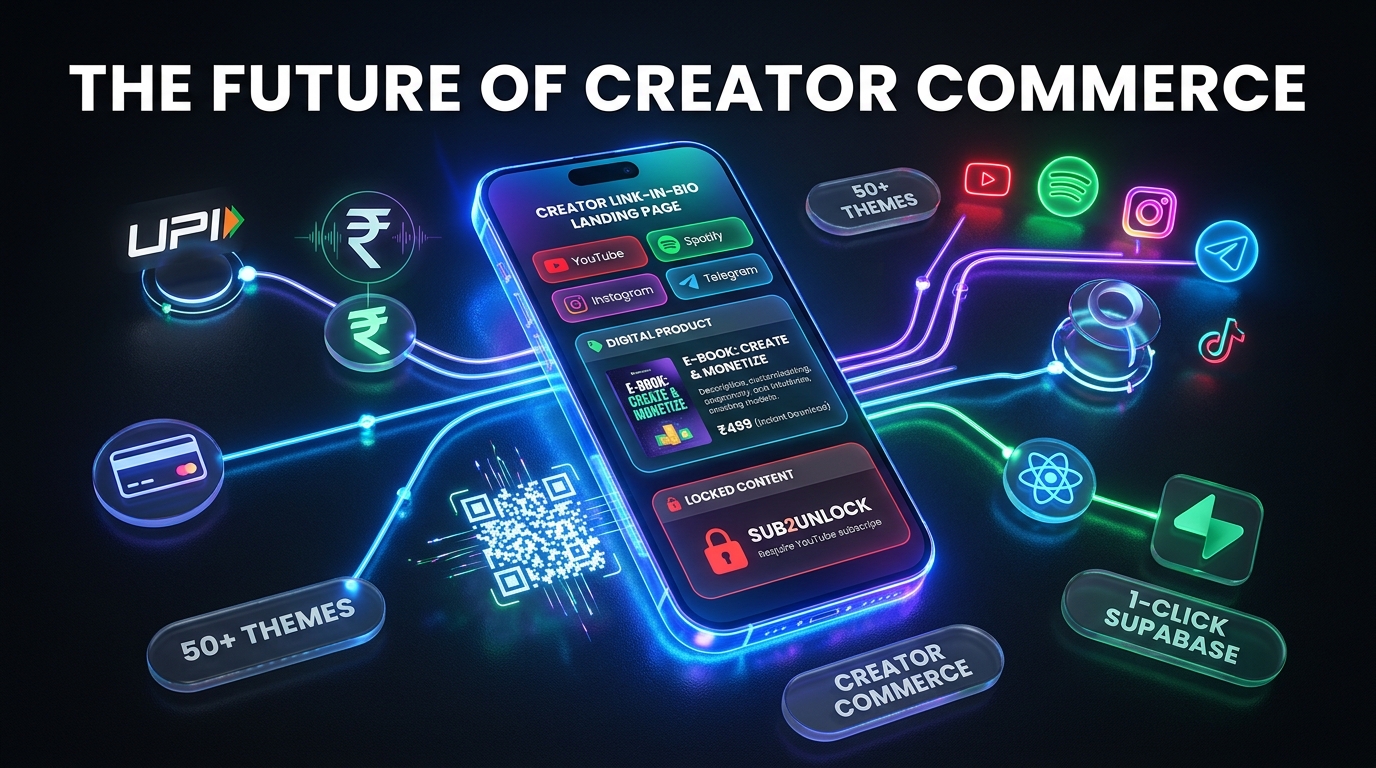
How to Launch a Link-in-Bio & Creator Store SaaS in 2026: The Linktree Clone Architecture (React 19 & Supabase)
Learn how to launch a profitable Link-in-Bio & Creator Store SaaS in 2026 using React 19, Vite, and Supabase. Discover how to monetize digital downloads, Sub2Unlock paywalls, 50+ themes, and turnkey commercial Linktree clone source code.

How to Build an Autonomous AI Website Builder SaaS in 2026: The Complete Bolt.new & Lovable Clone Architecture
Discover how to launch your own autonomous AI website builder SaaS like Bolt.new, Lovable.dev, and Cursor. Explore Monaco VS Code editor parity, multi-LLM streaming engines, 1-click Hostinger/cPanel FTP deployment, and turnkey white-label commercial source code.